
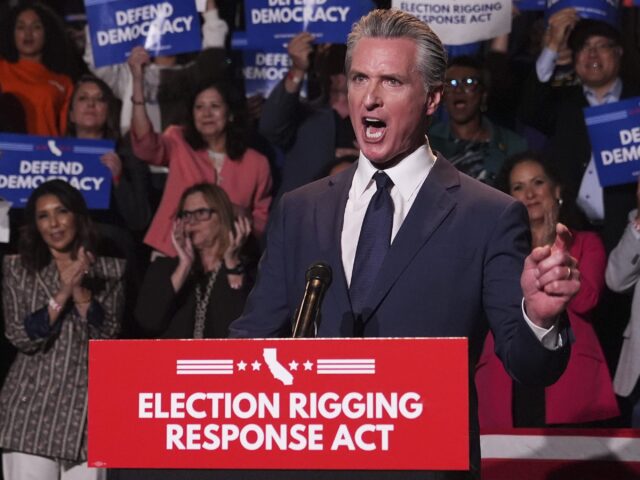
California Governor Gavin Newsom is once again at the center of a political storm — and this time, it’s about the federal government doing its job. On Sunday, Newsom lashed out after a U.S. Border Patrol operation took place just outside a rally he staged in downtown Los Angeles on Thursday. The governor, visibly angry, demanded answers about why federal agents were on the scene, framing the moment as an attack on what he called a “fair electoral process.”

But the event itself wasn’t just any rally. Newsom had gathered supporters in front of the Japanese American National Museum in Little Tokyo to push a controversial plan that many critics see as a direct assault on California’s nonpartisan redistricting process. The governor framed the effort as a move to “defend democracy,” yet the real goal was plain: redraw district maps in a way that would erase several Republican-held seats and lock in Democratic power. For many, that looked less like defending democracy and more like tilting the scales.
As Newsom prepared to speak inside, witnesses reported a strong federal presence outside. “More than a dozen Border Patrol agents turned up in downtown Los Angeles on Thursday at a rally and news conference that Gov. Gavin Newsom was holding on congressional redistricting,” the New York Times noted. The agents, some masked, armed, and wearing tactical helmets, drew sharp criticism from Democrats, who accused the federal government of intimidation. Yet federal authorities did make an arrest, according to Fox News — a clear indication that this was not simply a random show of force but a law enforcement action based on intelligence. Homeland Security Secretary Kristi Noem even suggested the operation would not have been conducted without cause.
Acting U.S. Attorney Bill Essayli dismissed the outrage, posting on X that the governor’s concerns were overblown. That perspective resonated with many who see the controversy as political theater designed to distract from the more pressing issue: California’s ruling class is focused on power games while law enforcement faces the real burden of keeping communities safe.
Nevertheless, Democrats turned the incident into a rallying cry. Los Angeles Mayor Karen Bass, who has already taken a hard stance against federal immigration enforcement, piled on, having previously boycotted events in protest of ICE actions. For her and others, the sight of federal agents doing their job was treated as an unacceptable intrusion — even if it meant removing individuals who may have posed risks to public safety.
By Sunday, Newsom’s office escalated the fight. His team filed a Freedom of Information Act request demanding detailed records on the Border Patrol’s activity. In his statement, the governor claimed: “On August 14, as Governor Newsom and other California elected leaders announced the Election Rigging Response Act to counter President Trump’s attempt to rig the mid-term elections, dozens of armed and masked U.S. Customs and Border Patrol (CBP) agents descended upon the Japanese American National Museum in Downtown Los Angeles. This attempt to intimidate the people of California from defending a fair electoral process was a grotesque use of federal government resources for political grandstanding.”
What stood out in the letter, however, was a remarkable demand: Newsom also insisted that the administration reveal any communications with Fox News. That request brushes directly against the First Amendment’s protections of a free press, raising eyebrows among those who see it as a glaring example of government overreach. When politicians attempt to pry into press communications, it signals a troubling willingness to chip away at constitutional freedoms in pursuit of political advantage.
For conservatives, the picture is clear: while the federal government was carrying out a legitimate operation, California’s governor used the moment to advance a narrative of victimhood — and to press for redistricting maneuvers that could entrench one-party rule. At the same time, his administration’s FOIA request highlights a deeper irony. The same leaders who preach about democracy and fairness are willing to sidestep constitutional principles when it serves their partisan interests.
In the end, the clash outside the museum is about far more than one arrest or one rally. It’s about the growing divide between leaders who prioritize political dominance and those who still believe in common-sense enforcement of the law, respect for constitutional boundaries, and accountability to taxpayers who ultimately foot the bill for both the rallies and the raids.