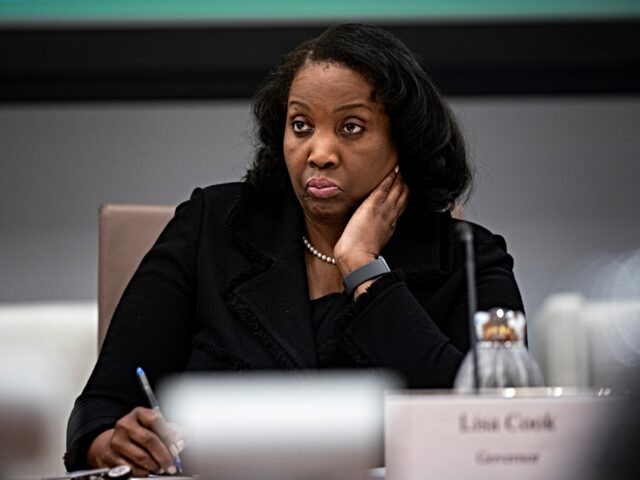
President Donald Trump on Friday made it clear he is prepared to take decisive action if Federal Reserve Governor Lisa Cook does not step aside following serious allegations of mortgage fraud.

“What she did was bad,” the 47th president told reporters. “So I’ll fire her if she doesn’t resign,” he added.
The controversy began after Federal Housing Finance Agency (FHFA) Chair Bill Pulte revealed troubling inconsistencies in Cook’s financial disclosures. “We have obtained a document Lisa Cook submitted to the U.S. Government while serving as Federal Reserve Governor. In it, on February 28, 2023, she represents to the U.S. Government that the Atlanta Property is her PERSONAL RESIDENCE. However, Lisa Cook, as a then-sitting Fed Governor and six months earlier, on September 1, 2022, appears to have listed that same property for RENT,” Pulte stated.
Such discrepancies suggest Cook may have misrepresented her primary residence status to secure favorable loan terms—behavior that, if proven, could amount to mortgage fraud. That raises not only legal concerns but also serious questions about the credibility of one of the most powerful institutions in the nation. The Federal Reserve’s ability to set monetary policy is already viewed by many Americans as too far removed from accountability. Now, allegations of misconduct inside its leadership add fuel to concerns about bureaucratic overreach and lack of transparency.
Adding to the pressure, Ed Martin, the United States Pardon Attorney at the Justice Department, urged Fed Chairman Jerome Powell in a Thursday letter to push for Cook’s resignation. Martin said it appears Cook “has falsified bank documents and property records to acquire more favorable loan terms, potentially committing mortgage fraud under the criminal statutes.” For a senior federal official tasked with overseeing economic policy, such accusations carry heavy weight.
Despite mounting scrutiny, Cook has stood her ground. “I have no intention of being bullied to step down from my position because of some questions raised in a tweet,” Cook said in a statement. “I do intend to take any questions about my financial history seriously as a member of the Federal Reserve and so I am gathering the accurate information to answer any legitimate questions and provide the facts.”
Cook’s refusal to resign highlights a larger issue: the culture of resistance among Washington elites who often cling to positions of power even when their integrity is in doubt. For taxpayers, the concern is clear—if those entrusted with managing the nation’s financial system cannot uphold basic ethical standards, how can the public have confidence in the system itself?
This is not Cook’s first brush with controversy. During her Senate confirmation process, her record drew attention for statements that echoed progressive priorities over traditional economic principles. She previously signaled support for using racial unemployment rates as a primary metric for economic health, rather than the broader unemployment rate established by Congress’s dual mandate of full employment and stable prices. Michael Linden, then an adviser at the Office of Management and Budget, once wrote, “The Black unemployment rate is a better indicator for the health of the overall economy than a lot of more ‘standard’ metrics that many people tend to use.” Cook responded simply: “Agree.”
She has also argued that systemic racism underpins not only disparities in health and work but also environmental outcomes, claiming in 2020 that the economy is “trillions of dollars smaller than it should be because of racism.” In 2019, she charged that “lack of diversity was the root of the financial crisis and the Great Recession.” At one point, she even replied “Yes!” to a suggestion that American democracy had survived Donald J. Trump.
Taken together, these remarks paint a picture of a policymaker whose focus has often drifted from sound economics to divisive ideological narratives. The Federal Reserve, however, was designed to maintain independence from partisan politics, focusing instead on stable prices and steady employment. Cook’s record raises legitimate concerns about whether ideology has begun to overshadow economic stewardship at the nation’s central bank.
The unfolding controversy underscores why Trump’s hard line matters. The Federal Reserve holds immense power over interest rates, inflation, and the broader economic climate—power that touches every American household. If misconduct is tolerated within its leadership, it erodes public trust and threatens to further entrench an unelected bureaucracy unaccountable to the people it ultimately serves.
For conservatives, the issue is not only about one official’s alleged wrongdoing. It is about ensuring that institutions with such sweeping influence remain transparent, accountable, and free from political agendas. At a time when families are already stretched thin by inflation and rising borrowing costs, the last thing Americans need is a Fed leader clouded by allegations of dishonesty.
Whether Cook resigns voluntarily or faces removal, the controversy has already shined a spotlight on a fundamental question: who is really looking out for the American taxpayer?