

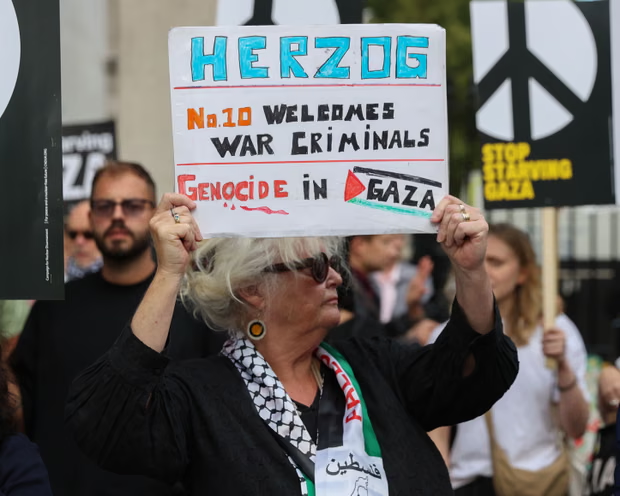
Britain’s new prime minister insists on pushing a two-state “solution” that Israel no longer trusts? Keir Starmer’s meeting this week with Israeli President Isaac Herzog at No. 10 revealed just how wide that gulf has grown—and why it may damage Britain’s standing with its closest ally in the Middle East.

Downing Street had hoped for dialogue. Officials thought Herzog might assist in humanitarian initiatives, like evacuating injured children from Gaza or helping Palestinian students reach the UK. Instead, the conversation exposed a fundamental clash: Starmer’s insistence on elections for Palestinians and a reconstituted Palestinian Authority versus Herzog’s hardened belief that faith in Palestinian self-rule died on October 7, 2023.
Herzog, once a supporter of a two-state framework, now reflects the view of most Israelis—that until Hamas is dismantled and hostages freed, talk of Palestinian sovereignty is not only premature but dangerous. He praised Prime Minister Benjamin Netanyahu’s strike on Hamas leadership in Doha, calling it “important and correct,” while Starmer condemned it as a violation of Qatar’s sovereignty. The split couldn’t have been clearer: one side focused on security and survival, the other trapped in legal theory and appeasement politics.
Even Starmer’s own ministers exposed the bind. Health Secretary Wes Streeting demanded to know how Israel could achieve its goals in Gaza “without ethnic cleansing, or even without genocide.” The accusation—echoing the language of the far Left—only reinforces why Labour’s stance unnerves Israel, which views recognition of a Palestinian state now as nothing short of rewarding Hamas.
Herzog’s position is backed quietly by Washington, which has already denied visas to the Palestinian Authority’s UN delegation. But Europe’s mood is shifting. New polling shows 75% of Britons believe Israel’s military actions in Gaza have gone too far, while only 11% think Israel hasn’t gone far enough. Nearly half say the UK should recognize a Palestinian state, a sentiment Labour may exploit to shore up support on the Left—even as it risks losing moderates to Reform UK over immigration and border failures.
For Starmer, the problem runs deeper than foreign policy. Gaza is fast becoming a rallying cry for the Greens, the Corbynite Left, and others eager to fracture Labour’s base. Already, 49% of the public believes Starmer has mishandled the issue. His attempt to balance international law rhetoric with realpolitik has satisfied no one, leaving him vulnerable at home and distrusted abroad.
Herzog left London knowing Israel has lost the battle for European public opinion. Starmer left the meeting no closer to clarity on Britain’s role in the region, except perhaps proving one thing: the Labour Party’s instincts remain closer to appeasing the Left than standing with Israel.