

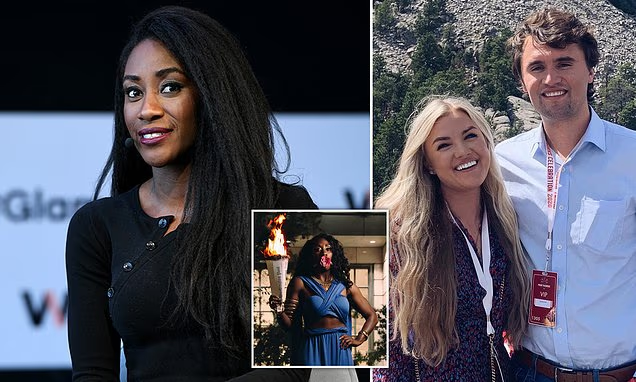
When news breaks about political violence, the instinct in much of the corporate press is to shape the narrative rather than simply report it. That reality became impossible to ignore this week after a former Washington Post columnist revealed she had been fired over a string of controversial social media posts—posts that surfaced in the wake of the assassination of conservative leader Charlie Kirk and a school shooting in Colorado.

“On Bluesky, in the aftermath of the horrific shootings in Utah and Colorado, I condemned America’s acceptance of political violence and criticized its ritualized responses — the hollow, cliched calls for ‘thoughts and prayers’ and ‘this is not who we are’ that normalize gun violence and absolve [W]hite perpetrators especially, while nothing is done to curb deaths,” Karen Attiah wrote in her Substack announcement.
The timing of her commentary could not have been more striking. Kirk, one of the nation’s most prominent conservative activists, was assassinated at a campus event in Utah. Hours later, a separate tragedy unfolded in Colorado when a student opened fire at a school, injuring two before turning the weapon on himself. These twin events brought into focus not only the growing crisis of violence in American life but also the fault lines in how different sides of the political spectrum respond to tragedy.
Attiah’s posts went beyond generic lamentations about violence. She uploaded screenshots of her own commentary, including one that read: “Part of what keeps America so violent is the insistence that people perform care, empty goodness and absolution for [W]hite men who espouse hatred and violence.” Such framing does not merely criticize political violence; it imposes a broad indictment against an entire demographic. In an age where corporate outlets claim to be guardians of fairness, this kind of sweeping language rings familiar to anyone who has watched identity politics overshadow honest debate.
She acknowledged making a direct reference to Kirk, quoting: “‘Black women do not have the brain processing power to be taken seriously. You have to go steal a [W]hite person’s slot’ – Charlie Kirk.” The remark was tied to Kirk’s critique of affirmative action policies, where he singled out several high-profile liberal figures. Whatever one thinks of Kirk’s phrasing, Attiah’s decision to amplify the quote amid his assassination struck many as inflammatory.
Attiah insisted her firing was unjustified. “The Post accused my measured Bluesky posts of being ‘unacceptable’, ‘gross misconduct’ and of endangering the physical safety of colleagues — charges without evidence, which I reject completely as false. They rushed to fire me without even a conversation. This was not only a hasty overreach, but a violation of the very standards of journalistic fairness and rigor the Post claims to uphold,” she wrote, pairing her defense with an image of herself and Washington Post owner Jeff Bezos.
Her argument went further, framing her removal as part of a sweeping campaign against certain voices. “What happened to me is part of a broader purge of Black voices from academia, business, government, and media — a historical pattern as dangerous as it is shameful — and tragic,” she declared. Yet such claims illustrate a familiar pattern in legacy media: when progressive commentators face consequences for incendiary statements, the focus quickly shifts to systemic oppression, while little attention is paid to the basic responsibility that comes with a public platform.
Meanwhile, thousands gathered in Washington, D.C., for a candlelight vigil honoring Charlie Kirk. The service underscored the seriousness of the loss and the enduring importance of faith and community in times of crisis—values often dismissed in elite media circles as clichés but cherished by millions of Americans.
The episode raises larger questions. Who decides which voices are given space in major outlets? Why do so many institutions default to viewing tragedy through the lens of identity politics rather than shared human dignity? And why is it acceptable for journalists to deride prayer and faith as hollow when, for countless families, those traditions are the bedrock of resilience?
At its core, this story is not just about one columnist’s dismissal. It is about the deeper cultural rift between the values of ordinary Americans—faith, responsibility, and respect for life—and the narratives pushed by elite institutions increasingly disconnected from their audience. As the nation reckons with violence and division, the question is whether those entrusted with informing the public will rise above ideological battles or continue to weaponize them at the expense of truth and unity.