

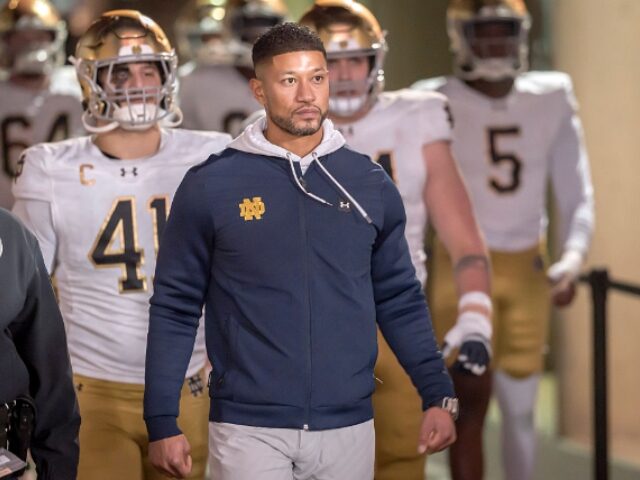
Notre Dame was informed Sunday by the College Football Playoff (CFP) Committee that it would not be included in this year’s playoff field, and within hours the university announced it would also decline participation in any postseason bowl game. The decision marked one of the most high-profile reactions to the current playoff selection system in recent years and immediately raised broader questions about transparency, media influence, and the concentration of decision-making power in college athletics.

In a formal response, the university stated, “We appreciate all the support from our families and fans, and we’re hoping to bring the 12th national title to South Bend in 2026.” The message signaled that the program viewed the outcome not as an end, but as a milestone in a longer-term effort to compete for national championships, even as it stepped away from a bowl opportunity that typically provides additional revenue exposure and visibility.
On the field, Notre Dame’s season showed a sharp turnaround. After losing its first two games, the team won 10 straight matchups, outscoring opponents by an average of 31 points per game. For more than a month leading up to the final CFP rankings, Notre Dame was placed ahead of Miami in weekly polls and was also ranked above Alabama for multiple weeks. That position shifted late when the committee elevated Alabama after what was described as a narrow victory over a five-win Auburn team, creating a dramatic late-season change in the projected playoff landscape.
In the final CFP rankings, the committee awarded the last two at-large spots to Alabama and Miami, leaving Notre Dame outside the playoff field. According to On3’s Brett McMurphy, Notre Dame was subsequently invited to compete in the Pop-Tarts Bowl against BYU, a team that also missed the playoff despite finishing with an 11–2 record. Rather than accept the invitation, Notre Dame chose to step away entirely.
Public reaction has been divided. Some critics online characterized the decision as overly cautious, while others argued the move reflected broader concerns about how selections are made and who ultimately benefits from those outcomes. Attention has focused less on the bowl itself and more on the ranking process and how it unfolded publicly in the weeks leading up to the final announcement.
In the buildup to the final rankings, ESPN’s CFP selection show repeatedly presented explanations for ranking Notre Dame ahead of both Miami and, at times, Alabama. Those broadcasts created an expectation among players, coaches, and university leadership that a playoff berth remained highly likely. The sudden reversal in the final ranking added to the sense of procedural instability surrounding the process.
Notre Dame Athletic Director Pete Bevacqua addressed the situation directly in comments to Yahoo Sports, saying, “There is no explanation that could possibly be given to explain the outcome. As I said to [hwad coach] Marcus, one thing is for sure: Any rankings or show before this last one is an absolute joke and a waste of time. Why put these young student-athletes through these false emotions just to pull the rug out from underneath them, having not played a game in two weeks, and then a group of people in a room shatter their dreams without explanation? We feel like the playoff was stolen from our student-athletes.”
Additional scrutiny has focused on the role of broadcast partners in shaping public narratives. During ESPN’s College Gameday and throughout conference championship broadcasts, several commentators repeatedly argued in favor of Miami advancing over Notre Dame. With the proposed Pop-Tarts Bowl set to air on ABC, which is owned by ESPN, observers have noted that the financial and media relationships surrounding postseason games add another layer of complexity to how postseason opportunities are distributed and perceived.
The episode highlights ongoing structural questions in college football regarding the balance between centralized decision-making and competitive fairness, the influence of media partners that also hold broadcast rights, and how increased commercialization shapes the postseason landscape. As playoff formats continue to evolve, the situation has added new focus on transparency, accountability, and the impact such decisions have on student-athletes, institutions, and the credibility of the sport’s governing systems.