

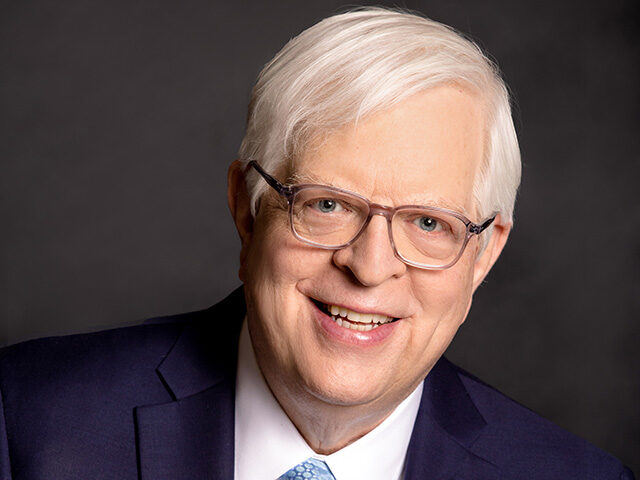
Conservative radio host and author Dennis Prager marked one year since the accident that left him paralyzed by reflecting on his recovery, his outlook on life, and his broader concerns about the direction of the country. In a recent interview with PragerU CEO Marissa Streit, Prager described the physical realities of his condition while emphasizing gratitude for his ability to continue speaking and engaging publicly.

“I remain paralyzed, but the biggest work, in fact, virtually all the work that has been done has been to enable me to breathe better, because the nerves to my diaphragm have been severely injured,” Prager said. He explained that medical efforts have focused primarily on restoring and supporting his breathing, a critical function affected by the injury.
Prager noted that physicians have expressed surprise at his ability to communicate. “A number of doctors, independently of one another, have described the fact that I am talking as ‘a miracle.’ And these are not religious people. I am cognizant of how lucky I am to be able to speak. No brain damage,” he continued. His remarks highlighted both the seriousness of the injury and the unexpected aspects of his recovery, particularly given the neurological damage involved.
Reflecting on his past writings, Prager connected his current circumstances to themes he explored long before the accident. “Everything I wrote in my happiness book has been realized,” he said. “I wrote, among many other things, ‘Life is a tragedy, as well as a glory, that gratitude is everything.’” He described gratitude as a central factor in how he has processed the past year. “Gratitude has been a large measure of what has sustained me,” Prager said. “I am so grateful for all this long life prior to my accident. And why would that leave? Because I had this terrible fall? Why would the gratitude be shattered? Do all those years not count?”
Prager expanded on this point by framing his experience as a broader reflection on how people assess hardship and fortune. “Everybody has to ask that question, ‘What about all the good years I’ve had?’ People who have terrible things happen go, ‘Why me?’ But they don’t go, ‘Why me’ when great things happen?” He added, “If nothing else, people should read my happiness book, Happiness Is a Serious Problem. And I am very grateful that I have a nature that has — great shock absorbers.”
The conversation later turned from personal recovery to Prager’s assessment of the country. When Streit asked, “How do you think America is doing right now?” Prager responded, “This bothers me even more than my own condition.” He explained that his concerns predate his injury and relate to shifts he has observed over several decades.
“I’ve been very worried for decades, and what I had not anticipated until a few years ago — it’s, too many of the leading intellectuals on the right have gone to ‘America only,’ and I don’t understand how they justify that if they are religious people,” Prager said. He grounded his remarks in religious teachings, adding, “One of the dominant themes of the Bible is, ‘Do not stand by on the blood of your neighbor’ — in other words, you can’t adopt the attitude, ‘Me only.’”
Prager referenced a well-known ethical principle from Jewish teaching to further explain his view. “One of the Bible’s famous dictums ‘in all of Jewish teaching’ is, ‘If I am not for me, then who will be for me? But if I am only for me, what am I?’” He said this framework informs how he believes Americans should think about their role in the world.
“Yes, we are first for America, just as we are first for our family,” Prager said. “There are a number of firsts, but anyone who is only for their family or only for America is not a moral person.” He then pointed to America’s global position. “God or man or luck or hard work has made America the strongest country in the world, economically, militarily, culturally,” Prager said. “And those who believe God was involved should certainly believe that God wants us to use it for the good of mankind, not just for America.”
Prager concluded by returning to his concern about what he described as a narrowing outlook in public debate. “And now we have voices that are saying ‘just for America,’” he said. “I don’t know how they just justify it if they are religious people.”