
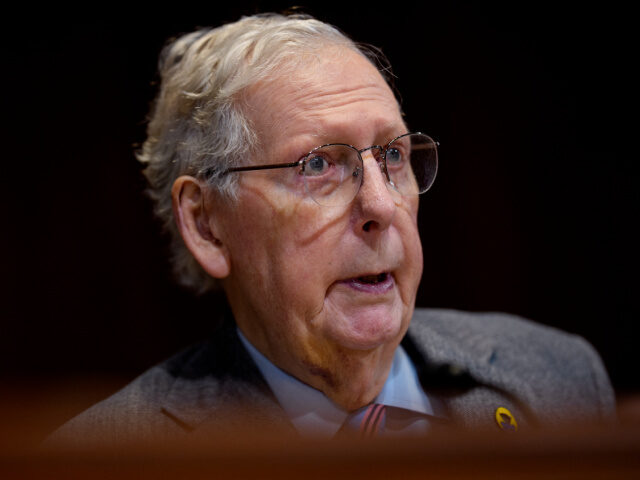
With Sen. Mitch McConnell set to leave office at the end of his current term, closing more than four decades in the U.S. Senate, attention in Kentucky has turned to the number of buildings, programs, and public spaces that have carried or continue to carry his name. At least eight such entities across the state are tied to McConnell, reflecting a long period in which federal influence, appropriations, and political relationships shaped local projects, institutions, and infrastructure.

McConnell’s career has coincided with significant federal investment in Kentucky, much of it routed through earmarks and competitive funding programs that were more common in earlier decades. Supporters have credited those efforts with attracting resources for economic development, education, and civic initiatives. Critics have raised questions about the long-term outcomes of some projects and the broader role of federal spending in state and local affairs. As McConnell prepares to step away, the scope of his institutional footprint has become part of the discussion surrounding his legacy and the future direction of Kentucky’s leadership.
Several prominent Republicans seeking to succeed McConnell, including Rep. Andy Barr and former Kentucky Attorney General Daniel Cameron, have publicly described him as a mentor. They are facing competition from businessman Nate Morris, who has positioned his campaign as distinct from McConnell’s brand of leadership. McConnell, Barr, and Cameron were contacted for comment on the naming of public institutions but did not respond.
One of the most visible examples is the Mitch McConnell Building, which serves as the headquarters of the Republican Party of Kentucky in Frankfort. The party has operated from the site for more than five decades. In November 2025, it marked the opening of a major expansion that added new meeting and event spaces. Party officials credited McConnell with helping raise funds for the project and described the expansion as a symbol of organizational growth and long-term investment in party infrastructure.
In Bowling Green, RiverWalk Park was renamed RiverWalk at Mitch McConnell Park in 2004. Local officials at the time cited McConnell’s role in securing $4.5 million in federal funding for riverfront improvements, part of more than $55 million directed to Warren County. Businessman David Garvin proposed design enhancements using the allocated funds and committed to covering overruns or returning excess money. McConnell reviewed the plans but deferred decisions to city officials, stating he did not want to influence their judgment.
Owensboro’s riverfront includes McConnell Plaza, named after the senator following a $40 million federal investment in a river wall and park expansion in 2005. City and county leaders have linked the project to downtown revitalization efforts. McConnell also directed $3 million toward construction of the H.L. Neblett Community Center. Daviess County Judge-Executive Charlie Castlen said McConnell had been a friend to the area “pretty much out of the gate.”
At the University of Louisville, McConnell’s alma mater, the McConnell Center was founded in 1991 as a nonpartisan institution focused on leadership and civic education. Its programs include scholarships for Kentucky students, initiatives for K–12 educators, and military education offerings developed in coordination with the U.S. Army. The university also houses the U.S. Senator Mitch McConnell and Secretary Elaine L. Chao Archives and Civic Education Gallery, which preserves personal papers and official records documenting careers in public service. The collection was dedicated in 2009 during a ceremony that included remarks by Sen. John McCain.
Not all projects bearing McConnell’s name remain active. The McConnell Technology & Training Center in Louisville, a federally supported initiative that received more than $90 million in funding and was renamed following a $6 million earmark secured in 1996, ceased operations in 2013. One national political publication later described its collapse as “a classic case of a program or project that relies heavily on one lawmaker running into trouble when political fortunes shift.”
Other facilities have less clear current status. The Mitch McConnell Integrated Applications Laboratory at Western Kentucky University opened in 2005 as part of a $20 million science complex funded in part by more than $2.3 million in federal support. University spokesperson Jace Lux said he was unaware of the lab’s present status and noted that further clarification might come after faculty consultations. Similarly, references from the early 2000s describe a proposed or existing Mitch McConnell Center for Distance Learning at the University of Kentucky, potentially within its law school. The university has not responded to requests for information, though a January 14, 2009 column by journalist Joe Conason referred to “the wonderful Mitch McConnell Center for Distance Learning at the university’s law school.”
Together, these institutions illustrate how federal funding decisions, naming practices, and long-serving political influence intersect at the state and local level. As Kentucky prepares for a post-McConnell era, questions surrounding oversight, outcomes, and the durability of federally backed projects are likely to remain part of the broader conversation about governance, accountability, and the relationship between Washington and the states.