President Donald Trump publicly intensified his support for protesters in Iran on Saturday, pairing messages of encouragement with warnings directed at the country’s leadership as demonstrations continued inside Iran and spilled into high-profile protests abroad. Posting repeatedly on Truth Social, Trump wrote, “Iran is looking at FREEDOM, perhaps like never before. The USA stands ready to help!!!” as he highlighted signs of unrest and symbolic acts opposing the Islamic Republic.

Among the events Trump referenced was a protest at Iran’s embassy in London near Hyde Park, where demonstrators scaled the building and replaced the Islamic Republic’s flag with Iran’s pre-1979 lion-and-sun emblem. Video and images circulating online showed hundreds of people below chanting “Democracy for Iran” and “Free Iran” as the symbol associated with the era before the 1979 Islamic Revolution was raised. London police said additional officers were deployed and confirmed multiple arrests for aggravated trespass. The flag remained in place for several minutes before being removed.
Earlier in the day, Trump reposted a message from Sen. Lindsey Graham that responded to comments from Secretary of State Marco Rubio, who had stated, “The United States supports the brave people of Iran.” In the post Trump shared, Graham wrote that this is “truly not the Obama administration” when it comes to confronting “the Iranian ayatollah and his religious Nazi henchmen,” while standing behind Iranians “protesting for a better life.” Graham added, “To the regime leadership: your brutality against the great people of Iran will not go unchallenged,” and concluded with, “Make Iran Great Again.”
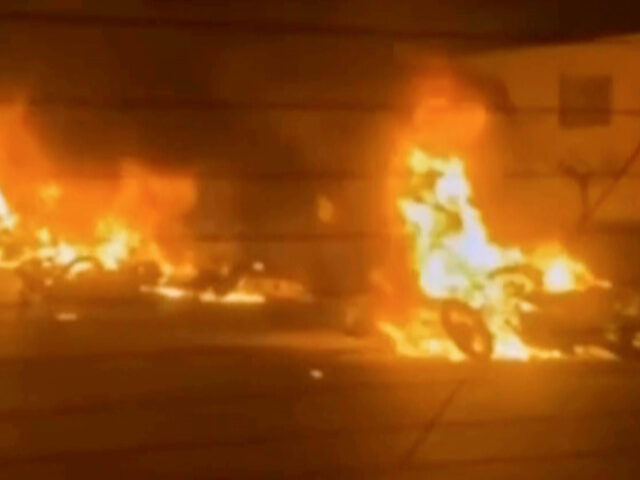
Trump’s statements came as protests that began on December 28 continued to expand across Iran, despite efforts by authorities to limit communication. The Iranian government imposed a sweeping internet blackout beginning Thursday night that extended through Saturday and into Sunday in Tehran, a move widely viewed as an attempt to disrupt coordination among demonstrators and limit the flow of information about the scale of unrest. Iranian officials have described the protests as the result of foreign interference, while critics point to economic pressures, governance issues, and public dissatisfaction as contributing factors.
The president’s warnings have escalated over several days. Speaking at the White House on January 9, Trump said the United States would act if Iranian authorities began killing protesters, while emphasizing that any response would not involve deploying ground troops. “I’ve made the statement very strongly that if they start killing people like they have in the past, we will get involved,” Trump said. “That doesn’t mean boots on the ground, but it means hitting them very, very hard where it hurts.”
In an earlier Truth Social post on January 2, Trump warned that if Iran “shoots and violently kills peaceful protesters, which is their custom,” the United States would “come to their rescue,” adding that American forces were “locked and loaded and ready to go.” He reiterated that position on January 8, saying the U.S. was “ready” to strike Iran hard if protesters were killed, though he noted that, “for the most part, they haven’t” been.
The heightened rhetoric coincided with reports that administration officials have held preliminary discussions about potential U.S. military options should Tehran intensify its crackdown. According to a Wall Street Journal report published Saturday, those discussions included the possibility of a large-scale aerial strike targeting Iranian military assets. Officials emphasized that the talks were routine contingency planning, that no decision had been made, and that no U.S. forces were being positioned, underscoring that the discussions were preparatory rather than operational.
Inside Iran, protest organizers and ordinary citizens have circulated messages on social media appealing for international attention and protection, including direct pleas urging Trump not to allow the regime to kill demonstrators. Human rights groups and opposition-linked sources have reported rising casualties and mass arrests, though precise figures remain difficult to verify amid the communications blackout. Iranian Supreme Leader Ayatollah Ali Khamenei criticized Trump in remarks on Friday as demonstrations continued and access to the internet remained restricted.
By Saturday night, Trump’s series of posts conveyed a consistent message: the United States is closely monitoring developments in Iran, publicly aligning itself with protesters’ calls for change, and signaling to Tehran that further escalation against demonstrators would draw heightened scrutiny from Washington.