
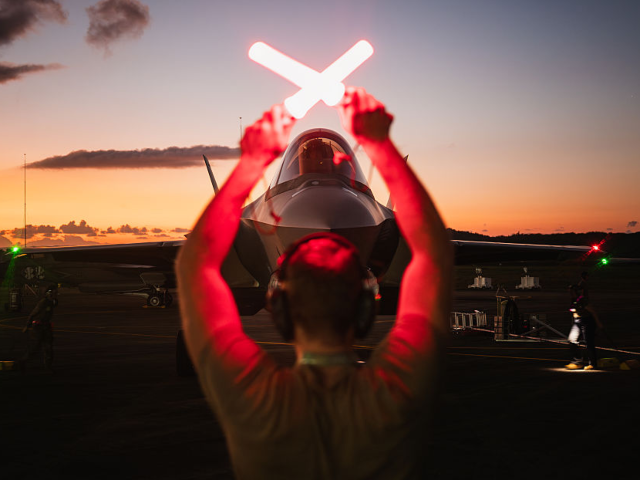
President Donald Trump is weighing possible military action against Iran that could occur “in the next 24 hours,” according to a Reuters report citing two European officials, as the United States begins drawing down personnel from key military installations across the Middle East and Iranian officials warn of retaliation if Washington proceeds with strikes.

The Reuters report, published Wednesday, said the European officials assessed that U.S. military intervention now appeared likely. One official said action could come within the next 24 hours, while an Israeli official separately told Reuters it appeared Trump had made a decision to intervene, though the scope and timing of any operation remained unclear. The assessment came as visible changes in U.S. military posture unfolded across the region, signaling heightened readiness amid escalating tensions.
A U.S. official told Reuters that the United States has begun a precautionary removal of personnel from key bases in the Middle East. The move follows warnings from a senior Iranian official that Tehran would strike American bases in neighboring countries if the United States targets Iran. According to the report, the drawdown is focused on reducing risk to U.S. personnel as tensions increase, rather than signaling a full-scale withdrawal.
That senior Iranian official, speaking on condition of anonymity, said Iran had warned regional governments — including Saudi Arabia, the United Arab Emirates, and Turkey — that U.S. bases on their territory would be attacked if Washington launches strikes. The official added that Tehran urged those countries to pressure the United States to stand down, underscoring the potential for the conflict to extend beyond Iran’s borders if military action occurs.
Qatar confirmed that personnel reductions are underway at Al Udeid Air Base, the largest U.S. military base in the Middle East and the forward headquarters of U.S. Central Command. Qatari officials described the move as a response to “current regional tensions.” Diplomats cited by Reuters said some personnel were instructed to depart Al Udeid by Wednesday evening, emphasizing that the change represents a posture adjustment rather than an ordered evacuation, with no immediate signs of a mass withdrawal similar to that seen ahead of an Iranian missile strike last year.
Britain has also begun withdrawing some personnel from a military airbase in Qatar, mirroring the U.S. posture shift as Washington evaluates its next steps. In a separate Reuters report, U.S. officials said the drawdown involves non-essential personnel, while noting that the White House is reviewing a range of potential options should Trump authorize action, including additional strikes on regime-linked infrastructure and possible cyber operations.
The regional military repositioning is unfolding alongside intensified internal unrest in Iran. Reuters reported that Iran’s leadership is seeking to suppress what officials and rights groups have described as the most violent unrest since the 1979 Islamic Revolution. Casualty figures continue to rise amid widespread internet blackouts that have limited independent verification. One Iranian official put the death toll above 2,000, while a rights group reported more than 2,600 killed, figures widely viewed as conservative given the regime’s restrictions on information.
Breitbart News has reported that independent estimates, constrained by communications blackouts and reports of mass burials, have placed the death toll far higher, with some assessments running as high as 12,000 or more nationwide as of Tuesday. Iranian officials have acknowledged that internal communications with the United States have stalled amid the crisis. The same senior Iranian official told Reuters that direct communications between Iranian Foreign Minister Abbas Araghchi and U.S. Special Envoy Steve Witkoff have been suspended, claiming U.S. threats had derailed diplomatic contacts related to the nuclear dispute.
Iran has paired its domestic crackdown with explicit warnings aimed at U.S. forces throughout the region. Iranian officials have stated that any American strike would prompt retaliation against U.S. military installations. Senior Iranian adviser Ali Shamkhani reinforced that message Wednesday morning, publicly pointing to Iran’s prior missile strike on Al Udeid following U.S. attacks on Iranian nuclear facilities last year as evidence of Tehran’s capacity to respond to renewed U.S. action.
Trump’s public warnings have intensified as the unrest has grown. In an interview with CBS News on Tuesday, the president vowed “very strong action” if Iran executes protesters, warned Tehran against retaliation, and said any response would be met at levels “never seen before.” The posture shift also follows days of escalating public statements from Trump tied directly to the killing of protesters. As Breitbart News reported Tuesday, Trump urged “Iranian Patriots” to “KEEP PROTESTING — TAKE OVER YOUR INSTITUTIONS!!!,” declared “HELP IS ON ITS WAY,” and warned regime “killers and abusers” they “will pay a big price.”
Trump first drew that red line earlier this month, warning that the United States was “locked and loaded” if Iran began mass executions, as the administration moved to isolate the regime diplomatically and economically. Separately, the U.S. State Department has urged American citizens to leave Iran as unrest and repression escalate, highlighting the deteriorating security environment.
For now, the reported timeline for potential U.S. action and the visible military posture appear to be moving in parallel, with American forces thinning out at critical bases across the Middle East and Iranian officials making clear that U.S. assets would be targeted if Washington strikes first.