
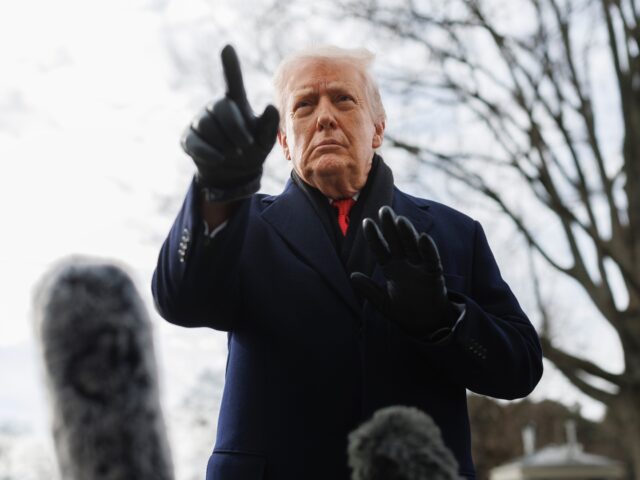
U.S. President Donald Trump on Saturday escalated a diplomatic dispute over Greenland by announcing a 10 percent tariff on eight European countries that oppose the United States acquiring the Danish autonomous territory. The move marks a significant shift from prior rhetorical pressure to direct economic measures, tying trade policy to an ongoing disagreement over control of a strategically located Arctic island. Trump framed the decision as a response to coordinated resistance from European governments, including Denmark, which has administered Greenland since the 18th century.

In a post on his Truth Social platform, Trump described Greenland as central to American and global security interests, writing that “world peace is at stake” and warning that “China and Russia want Greenland, and there is not a thing that Denmark can do about it.” He argued that Denmark lacks the capacity to defend the territory, quipping that Copenhagen has only “two dogsleds” to protect the island. Trump said that only the United States has the resources and military capability to secure Greenland against major geopolitical rivals.
Trump also linked the dispute to broader economic and defense arrangements between the United States and Europe. “We have subsidized Denmark, and all of the Countries of the European Union, and others, for many years by not charging them Tariffs, or any other forms of remuneration. Now, after Centuries, it is time for Denmark to give back,” he wrote. The administration announced that the tariffs would apply not only to Denmark but also to Finland, France, Germany, the Netherlands, Norway, Sweden, and the United Kingdom, all of which have committed to deploying military forces to Greenland in support of Denmark.
“These countries, who are playing this very dangerous game, have put a level of risk in play that is not tenable or sustainable,” Trump said, adding, “This is a very dangerous situation for the Safety, Security, and Survival of our Planet.” The tariffs are expected to be imposed on top of existing trade measures, including a 15 percent baseline tariff previously negotiated with the European Union and a 10 percent baseline tariff with Britain earlier this year. Trump warned that if the Greenland issue is not resolved by June, the newly announced 10 percent tariff would rise to 25 percent.
The president also emphasized Greenland’s role in emerging U.S. defense systems, citing its geographic importance for missile defense infrastructure. Referring to the Golden Dome missile defense system, Trump wrote, “Hundreds of Billions of Dollars are currently being spent on Security Programs having to do with ‘The Dome,’ including for the possible protection of Canada, and this very brilliant, but highly complex system can only work at its maximum potential and efficiency, because of angles, metes, and bounds, if this Land is included in it.” He noted that previous U.S. administrations had sought unsuccessfully for more than 150 years to acquire Greenland, saying that continued failure was no longer an option given current security requirements.
Trump said the United States is “immediately open to negotiation with Denmark and/or any of these Countries that have put so much at risk, despite all that we have done for them, including maximum protection, over so many decades.” While Greenlandic and Danish officials have so far rejected the idea of U.S. territorial control, the administration has signaled that discussions could include financial compensation for Copenhagen and Greenland’s approximately 57,000 residents.
A first formal meeting between U.S., Danish, and Greenlandic representatives took place this week at the White House and was chaired by Vice President JD Vance and Secretary of State Marco Rubio. Following the meeting, Danish and Greenlandic officials agreed to continue high-level talks but told Danish media that there remained a “fundamental disagreement” between the parties. The dispute now sits at the intersection of trade policy, alliance management, and Arctic security, with further negotiations expected in the coming months.