
During Monday’s broadcast of WBUR’s “Here and Now,” Minneapolis Mayor Jacob Frey addressed recent protests, law enforcement presence, and public order, focusing his remarks on events within his city while declining to weigh in on incidents that occurred elsewhere. Frey emphasized that the protests he has overseen in Minneapolis have been largely peaceful, while also acknowledging concerns about isolated incidents and the role of federal authorities.

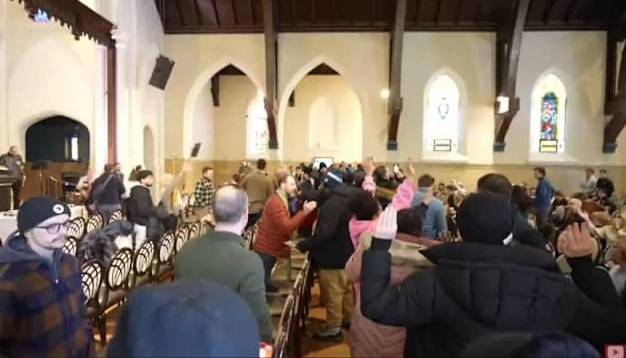
Frey said, “I can’t speak for the church protest, and, obviously, it doesn’t take place in Minneapolis. What I can say is, in Minneapolis, we’ve had tens of thousands of peaceful people peacefully protesting.” His comments referenced a protest at a church outside his jurisdiction, which he said limited his ability to assess the circumstances or motivations behind it. He noted that while places of worship carry particular significance, he did not have sufficient information to comment further.
Expanding on that point, Frey added, “It is unsettling. Again, I don’t know as much about it simply because it didn’t happen in Minneapolis. Granted, being in a church is a place that is sacred. Here’s what I would say: Certainly, that is not the route that I would’ve taken, individually, to protest in a church. I don’t know enough of the circumstances behind it, again, so I don’t want to comment on something that I’m not aware of.” His remarks underscored a distinction between protests occurring under his administration’s oversight and demonstrations in other locations.
Frey also addressed the presence of federal immigration authorities and troops, framing their involvement as counterproductive to maintaining calm. He stated, “We do not need more armed troops. We do not need more of an invasion or an occupation or whatever you want to call it. If the goal here is peace and order, then there’s a very easy antidote to achieve it, which is for ICE and the troops and anyone else to leave.” The comments came amid broader national debates over the appropriate balance between federal enforcement actions and local control of public safety.
At the same time, Frey said that Minneapolis has enforced consequences when demonstrations have crossed into violence. He concluded that when protesters have not remained peaceful, “there have been consequences, people have been arrested, and we don’t tolerate it.” His remarks highlighted the city’s stated approach of allowing lawful protest activity while maintaining enforcement mechanisms for actions that violate the law.