
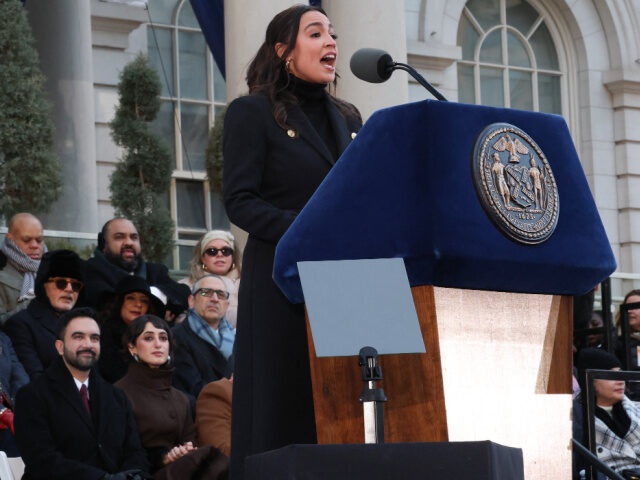
Representative Alexandria Ocasio-Cortez (D-NY) described the inauguration of New York City Mayor Zohran Mamdani as the beginning of a “new era” during remarks delivered at his public swearing-in ceremony on New Year’s Day. Mamdani, who assumed office following a closely watched mayoral race, enters City Hall at a time when the nation’s largest city is grappling with persistent challenges tied to affordability, public safety, infrastructure, and governance capacity. His administration is expected to influence not only local policy but also broader debates about the role of government in addressing economic and social concerns in major urban centers.

Speaking to supporters and city officials, Ocasio-Cortez framed Mamdani’s ascent as a shift in priorities and leadership style. “This ascent marks a new era for New York City, led by a historic new mayor in Zohran Mamdani, guided by his dedication to a working class that makes our beautiful city run,” she said at the ceremony. Her remarks emphasized themes of economic inclusion and political change, ideas that have featured prominently in Mamdani’s campaign messaging and public statements.
Ocasio-Cortez continued by describing the election outcome as a reflection of voter preferences. “New York, we have chosen courage over fear,” she stated. “We have chosen prosperity for the many over spoils for the few, and when the entrenched ways would rather have [us] dig in our feet and seek refuge in the past, we have chosen instead to turn towards making a new future for all of us.” The comments underscored a broader argument that city leadership should pursue structural changes rather than incremental reforms, particularly in areas affecting working families.
Expanding on those themes, the congresswoman added: “In Zohran Mamdani, we have chosen a mayor who is relentlessly dedicated to making life not just possible but aspirational for working people. New York City has chosen the ambitious pursuit of universal child care, affordable rent and housing, and clean and dignified public transit for all, and we have chosen that over the distractions of bigotry and the barbarism of extreme income inequality.” These policy goals align with proposals that would require significant public investment and expanded municipal authority, raising questions about funding sources, regulatory scope, and long-term fiscal sustainability.
Mamdani, a former New York State Assembly member, took his oath of office on the Islamic Quran in a private ceremony early Thursday morning. He has publicly identified as a democratic socialist and stated that his administration will seek to revive “the era of big government.” His swearing-in was conducted by Sen. Bernie Sanders (I-VT), a national figure closely associated with democratic socialist politics. Together, these symbolic and substantive choices highlight the ideological orientation Mamdani has said will guide his approach to governing.
As the new mayor begins his term, attention is likely to focus on how campaign pledges translate into policy implementation within the city’s complex bureaucratic structure. New York City’s budgetary constraints, regulatory environment, and relationship with state and federal authorities will play a central role in determining the scope and pace of any changes. The administration’s early decisions may offer insight into how expanded government programs are prioritized, managed, and financed, and how accountability is maintained within one of the country’s largest municipal governments.