
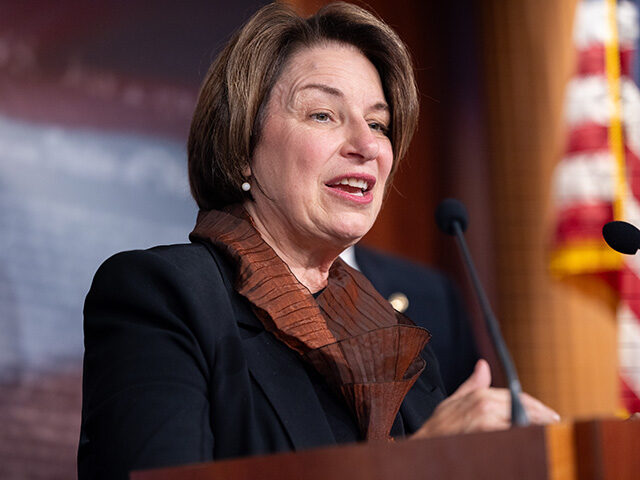
Sen. Amy Klobuchar (D-MN) is reportedly weighing a run for Minnesota governor following Gov. Tim Walz’s announcement that he will not seek reelection, according to multiple published reports. Walz, who was the Democratic Party’s vice-presidential nominee in 2024, confirmed Monday that he is ending his campaign, a decision that comes amid ongoing scrutiny related to a large-scale fraud case in Minnesota involving public funds. Shortly after Walz’s announcement, national media reported that Klobuchar has discussed the possibility of entering the gubernatorial race, citing sources familiar with conversations between the two officials during a meeting in Minnesota on Sunday.

According to those reports, Klobuchar’s consideration of a gubernatorial bid has prompted discussion about potential political succession plans within the state. Sources cited have indicated that one scenario under consideration could involve Klobuchar appointing Walz to the U.S. Senate if she were to become governor, a move that would allow Walz to remain in public office. Klobuchar, whose current Senate term runs until 2030, would not be required to relinquish her seat unless she won the governor’s race, meaning a loss would allow her to continue serving in the Senate.
As attention turns to the potential reshaping of Minnesota’s political leadership, past decisions from Klobuchar’s tenure as Hennepin County attorney in the late 1990s have resurfaced in public discussion. In 2012, reporting detailed her handling of an investigation involving Tom Petters, a Minnesota businessman who was later convicted in federal court of wire fraud, mail fraud, money laundering, and related offenses. Court records show Petters ultimately received a 50-year federal prison sentence and that his case became one of the largest Ponzi schemes in U.S. history.
Documents cited in earlier reporting indicated that evidence existed in 1999 that could have supported state-level prosecution of Petters, years before federal authorities brought charges. That reporting also noted that employees connected to Petters’ companies made campaign contributions to Klobuchar’s political efforts, including donations tied to her U.S. Senate run. One former Petters associate, Richard Hettler, told the Daily Caller, “She took Ponzi money to get elected.” Petters’ business network included individuals with longstanding ties to Minnesota’s political and legal institutions, including Ted Mondale, a former state senator and son of former Vice President Walter Mondale. Prior to becoming Hennepin County attorney, Klobuchar was a partner at a Minneapolis law firm where Walter Mondale had practiced law for years.
Additional commentary on the case has come from author Peter Schweizer, who said, “When [Tom Petters] finally got arrested by the FBI, one of the first calls he made was to Amy Klobuchar, who recommended the lawyer that he ended up hiring.” Schweizer added during a 2020 radio appearance, “It ended up being the second-largest — after Bernie Madoff — Ponzi scheme in U.S. history.” Klobuchar has not been charged with wrongdoing in connection with the Petters case, and no court has found that her actions violated the law.
Beyond her prosecutorial record, Klobuchar’s legislative history has also drawn renewed attention as speculation grows about her future plans. She played a central role in advancing the Journalism Competition and Preservation Act in 2022, legislation intended to reshape how media companies negotiate with large technology firms. Supporters framed the proposal as a way to sustain local journalism, while critics questioned its implications for market competition and government involvement in private industry.
Voting records and campaign finance disclosures further illustrate Klobuchar’s position within the Senate. As of 2020, she had voted with Sen. Bernie Sanders (I-VT) 88 percent of the time, according to publicly available data, and federal filings show she has been among the top recipients of corporate campaign contributions in the chamber. Schweizer described a pattern he observed, saying, “There are numerous examples where, you know, a particular company or, you know, a smaller industry — the executives will get together and she’ll get a couple dozen donations from a company over a two or three day period. And then within a couple of weeks, she’ll introduce legislation that specifically benefits that corporation. That’s one of the reasons she’s been such a prolific fundraiser.”
As of now, Klobuchar has not publicly confirmed whether she will enter the gubernatorial race. Her decision, if made, would shape Minnesota’s political landscape at a time when questions about public accountability, the use of taxpayer funds, and continuity of leadership remain central to statewide debate.