

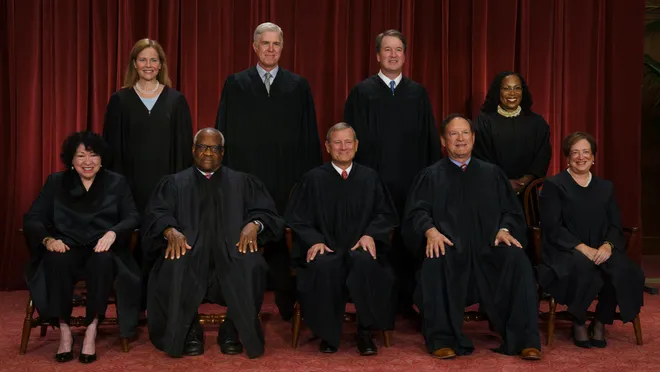
WASHINGTON – A quiet but consequential battle is unfolding in the courts, and it cuts right to the heart of how our system of government is supposed to work. When the Supreme Court issues a decision, the expectation is clear: lower courts are bound to follow it. Yet some of the justices themselves now fear that federal judges are sidestepping precedent—sometimes, they suspect, on purpose.

“Lower court judges may sometimes disagree with this Court’s decisions, but they are never free to defy them,” Justice Neil Gorsuch warned in a pointed statement, joined by Justice Brett Kavanaugh. His words came as the Court weighed in on an August 21 dispute involving Trump administration efforts to cancel health research grants tied to diversity, equity, and inclusion programs, or DEI.
For conservatives, the issue runs deeper than one grant program. It reflects a larger fight over bureaucratic overreach, taxpayer dollars, and whether unelected judges should block elected administrations from carrying out lawful policy. Gorsuch made it plain that a district judge had no authority to stop the administration’s decision after the Court itself had already ruled back in April that these types of disputes belong in a specialized court—the Court of Federal Claims, which handles government contract matters. To Gorsuch, the DEI research grants were “materially identical” to a previous case involving teacher training grants that the Court had already permitted the administration to halt.
But Chief Justice John Roberts, often a swing vote, joined the Court’s three liberal members in saying this case was different enough to allow the district judge’s order to stand, at least for now. That fractured alignment underscored how unsettled even the justices themselves remain over the proper boundaries. Justice Amy Coney Barrett offered a middle ground, suggesting part of the case could remain with the trial judge, but the rest should shift to the Federal Claims court.
The dissent from the left was sharper. Justice Ketanji Brown Jackson blasted the Court for allowing what she described as “the abrupt cancellation of hundreds of millions of dollars allocated to support life-saving biomedical research.” She argued that the Court’s earlier ruling, which spanned “half a paragraph of reasoning,” left lower courts guessing and unfairly tilted the scale in favor of the government. In a particularly colorful passage, Jackson wrote: “This is Calvinball jurisprudence with a twist. Calvinball has only one rule: There are no fixed rules. We seem to have two: that one, and this Administration always wins.”
For conservatives, Jackson’s protest reveals the real divide. To her, the problem is that the Court didn’t do enough to protect spending on programs rooted in DEI ideology. To Gorsuch and Kavanaugh, the problem is that lower court judges simply ignored clear instructions and undermined the authority of the Supreme Court itself. The stakes are more than academic. At issue is not only whether DEI-focused research deserves taxpayer funding, but also whether federal courts can rewrite the rules to keep such programs alive against the will of elected administrations.
The clash reflects a deeper historical struggle. Since the New Deal era, Washington has steadily expanded its control over education, health care, and research through complex grant programs and funding schemes. Every dollar spent represents taxpayer money, often funneled toward causes with ideological overtones. Conservatives have long warned that these grant programs can be used to advance political agendas rather than serve the broad public interest. The Trump administration’s decision to cancel DEI-focused grants fits within a larger push to restore common-sense limits on government spending and ensure that research funds serve national priorities rather than fashionable bureaucratic initiatives.
The Supreme Court’s emergency docket—cases decided quickly and with limited explanation—has only fueled the confusion. Legal observers note that brief rulings invite interpretation, but Gorsuch’s frustration highlighted a different concern: when lower courts take liberties with those interpretations, the balance of power tilts away from accountability and toward judicial activism. And that, conservatives argue, erodes both the rule of law and the separation of powers.
In the end, the NIH grant fight is about more than research funding. It is about whether unelected judges can override elected administrations, whether taxpayer money should fund politically charged programs, and whether the Court itself will enforce consistency across the judiciary. Gorsuch and Kavanaugh believe the answer should be simple: when the Supreme Court speaks, lower courts listen. If that principle wavers, the entire system risks descending into exactly what Jackson described—Calvinball, where the rules change depending on who is playing. And for a constitutional republic built on the idea of fixed laws, not shifting rules, that is no small warning.








I’m sick and tired of the lower courts trying to overturn everything because of TDS!! They tried their best to get him jailed so he couldn’t run for president, tying him up in the system. Law and order and justice flew out the window when it comes to Trump. Illegals get more priorities over Americans and they milk the taxpayers who pay in their entire lives. Time for judges who waste time and money with trying to get their way to pay fines.
Should be kaged browm a dei appointee itself has no ethics as all the satanist left judges. A civil war puts an end to the immoral elevating of those entitled lack of merit idiots. Sooner the better.