
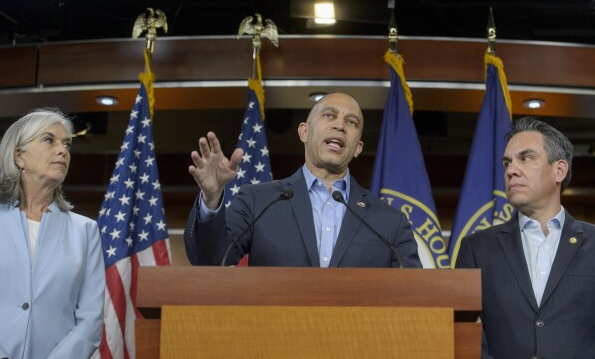
During an interview with Bloomberg on Friday, House Minority Whip Rep. Katherine Clark (D-MA) addressed questions surrounding the possibility of a government shutdown tied to disputes over Immigration and Customs Enforcement (ICE) and Department of Homeland Security (DHS) authorities. Her remarks came as lawmakers face another round of budget negotiations, with immigration enforcement and agency oversight once again emerging as points of contention in broader funding talks.

Clark emphasized that House Democrats’ stated approach to government funding has centered on negotiation rather than confrontation. She said, “We have had one approach around these government budgets, and that is negotiate and imploring our Republican colleagues to come to the table and negotiate with us. And we saw what happened back in the Fall.” Her comments referenced the most recent shutdown, which followed disagreements over extending Affordable Care Act (ACA) tax credits, a standoff that resulted in a prolonged halt to parts of the federal government.
Recalling that episode, Clark described the outcome in detail, stating, “We have had one approach around these government budgets, and that is negotiate and imploring our Republican colleagues to come to the table and negotiate with us. And we saw what happened back in the Fall, rather than coming and working with us around extending the ACA tax credits, they chose to go home, to close the government down, and to just leave town for over 40 days.” The previous shutdown disrupted federal operations, temporarily furloughed workers, and delayed services, effects that lawmakers on both sides have acknowledged can ripple through the broader economy.
The current debate involves proposals related to ICE and DHS, agencies that play central roles in immigration enforcement and border security. Funding for these departments is typically included in large, must-pass spending bills, making disagreements over their authorities and limitations particularly consequential. Clark framed the issue as one of negotiation over what she described as “guardrails” for these agencies, suggesting that unresolved disputes could again place government operations at risk.
“I certainly hope they are not going to make that choice now and do that again to the American people, to our economy, and to the message that it would send that they are unwilling to come and negotiate around guardrails for ICE and DHS,” Clark said. Her remarks highlighted concerns about the broader implications of a shutdown, including economic uncertainty, interruptions to public services, and signals sent to federal employees, businesses, and international partners.
Budget negotiations in Congress often bring together a wide range of issues beyond topline spending numbers, including healthcare policy, immigration enforcement, and administrative authority. Because government funding bills set operational limits for federal agencies, disagreements over policy direction can quickly translate into fiscal impasses. With statutory deadlines approaching, leaders in both parties face pressure to reach agreements that keep the government funded while addressing long-standing policy disputes.
As talks continue, the comments underscore how past shutdowns continue to shape current negotiations. Lawmakers frequently reference prior outcomes when signaling their positions, particularly when debates involve agencies responsible for law enforcement, border control, and national security. Whether negotiations result in compromise or another funding lapse will determine not only the immediate functioning of government but also the scope and authority of key federal institutions moving forward.