
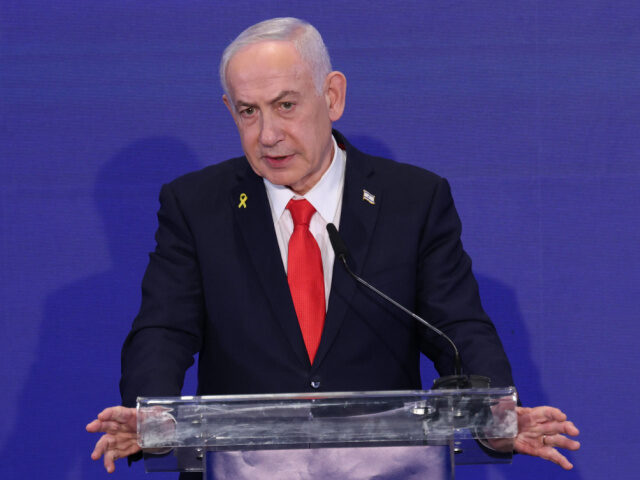
Israeli Prime Minister Benjamin Netanyahu announced Wednesday that Israel plans to invest roughly $110 billion over the next decade to significantly expand its domestic arms industry, a move aimed at reducing reliance on foreign suppliers during times of war. Speaking at a graduation ceremony for Israeli Air Force pilots, Netanyahu said he approved, alongside the defense and finance ministers, a multi-year plan totaling NIS 350 billion to ensure Israel can equip its military independently while maintaining its operational advantage. The announcement comes after more than two years of sustained conflict across multiple fronts, during which Israel encountered repeated political pressure and restrictions on weapons deliveries from abroad.

“We will continue to acquire essential supplies while independently arming ourselves,” Netanyahu said. “I don’t know if a country can be completely independent, but we will strive to ensure our arms are produced as much as possible in Israel.” He added, “Our goal is to build an independent arms industry for the State of Israel and reduce the dependency on any party, including allies.” The initiative is one of the largest defense-industrial investments in Israel’s history and reflects concerns about the reliability of foreign arms access during wartime, even among long-standing partners.
Netanyahu’s remarks build on comments he made last month rejecting reports that Israel is seeking a new long-term U.S. military aid framework, stating that his “direction is the exact opposite” and that Israel is moving toward “greater independence,” particularly in arms production. According to the prime minister, the investment will span munitions, weapons systems, and selected aerial platforms, with Israeli defense engineers and companies already developing technologies intended to preserve long-term military superiority. While Israel will continue to rely on the United States for certain major platforms, including fighter jets, refueling aircraft, and helicopters, it already maintains a substantial domestic defense sector producing unmanned aerial systems and advanced munitions.
The shift follows a period in which several allied governments imposed or threatened restrictions on arms sales to Israel during the Gaza war. These included temporary limitations from the United States under the Biden administration and more extensive measures from some European countries. Spain approved a sweeping arms embargo while Prime Minister Pedro Sánchez accused Israel of committing “genocide” in Gaza, even as Spanish trade data later showed continued purchases of Israeli weapons systems. Other governments, including Australia, publicly criticized Israel’s conduct while continuing to rely on Israeli military technology.
These developments have intensified debate over the balance between strategic alliances and wartime dependency. Israeli officials have increasingly argued that reliance on foreign arms supplies can constrain national decision-making during conflict and expose the country to political leverage over weapons deliveries. Netanyahu has framed the experience as a strategic lesson, warning that external limitations can emerge quickly during crises. In September, he sparked political and market backlash when he said Israel may need to become a self-reliant “super-Sparta,” remarks he later clarified as referring specifically to the defense sector rather than the broader economy. “There is one area where political, not economic, limitations exist — and that is the defense industries,” Netanyahu said at the time.
Despite the emphasis on independence, Israeli officials have stressed that the policy does not signal a retreat from cooperation with Washington. Netanyahu has repeatedly stated that U.S.–Israel defense ties remain mutually beneficial, noting that most American military aid to Israel is spent in the United States, supporting U.S. defense jobs, research, and innovation. This perspective was echoed recently when Sen. Lindsey Graham argued that American military aid to Israel delivers “tenfold” returns to U.S. security and defense capabilities, highlighting the ongoing strategic interdependence between the two countries.
Israel’s Defense Ministry has set the defense budget for 2026 at NIS 112 billion, or roughly $31 billion, with defense spending projected to account for about 16 percent of the national budget. The scale of the investment underscores the security demands Israel faces in a volatile regional environment and the government’s assessment that long-term preparedness requires greater control over weapons production. “If there is one lesson,” Netanyahu has said in recent months, “it is that Israel must not be in a position where others can limit us.” With the decade-long plan now approved, Israel is signaling a sustained shift toward military self-reliance while seeking to preserve both its technological edge and key international partnerships.