
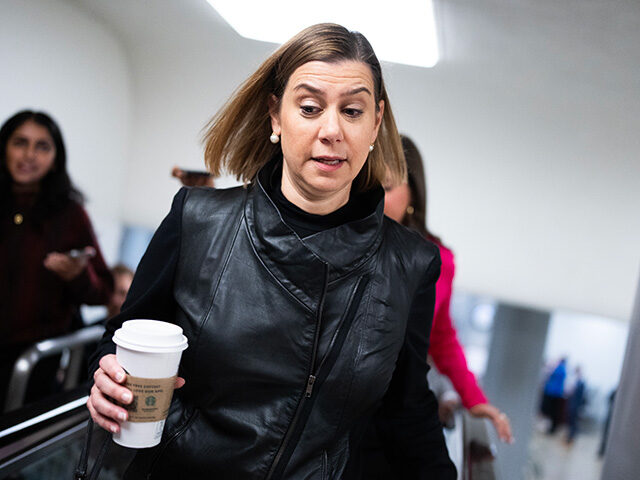
Sen. Elissa Slotkin (D-MI) admitted on Sunday that, to her knowledge, she was “not aware” that President Donald Trump had ever issued an illegal order to U.S. military service members. Her comments came during an interview on ABC’s This Week, where the conversation quickly shifted toward a growing political firestorm—one fueled by a video in which several Democrat lawmakers openly suggest that troops may need to disobey presidential orders.

The controversy began when host Martha Raddatz referenced the White House’s rebuke of the video. White House press secretary Karoline Leavitt had already pushed back, accusing Democrats of implying that Trump “has given illegal orders, which he has not.”
When Raddatz asked Slotkin whether Leavitt’s statement was “accurate,” Slotkin claimed that Democrats released their video because they allegedly received a “sheer number” of messages from troops and young officers unsure about what they “should do.” The framing raised eyebrows, as it implied that questions about lawful authority were being seeded long before any orders were actually given.
Pressed directly by Raddatz—“Do you believe President Trump has issued any illegal orders?”—Slotkin conceded:
“To my knowledge, I am not aware of things that are illegal — but certainly there are some legal gymnastics that are going on with these Caribbean strikes, and everything related to Venezuela.”
Her answer reinforced a familiar pattern: acknowledging no illegal actions, while insinuating ambiguity meant to cast doubt. For many observers, especially those concerned with national security and stable civilian–military relations, this kind of messaging carries real consequences. It places political theater above the chain of command and risks undermining trust within the armed forces—an institution that relies on clarity, discipline, and constitutional authority, not shifting political narratives.
Trump responded forcefully in a Truth Social post, writing on Saturday:
“THE TRAITORS THAT TOLD THE MILITARY TO DISOBEY MY ORDERS SHOULD BE IN JAIL RIGHT NOW, NOT ROAMING THE FAKE NEWS NETWORKS TRYING TO EXPLAIN THAT WHAT THEY SAID WAS OKAY. IT WASN’T, AND NEVER WILL BE! IT WAS SEDITION AT THE HIGHEST LEVEL, AND SEDITION IS A MAJOR CRIME. THERE CAN BE NO OTHER INTERPRETATION OF WHAT THEY SAID!”
The former president’s reaction underscored what many view as the real danger: elected officials encouraging service members to pre-judge the legality of orders based on partisan speculation rather than established military law. In an era where public trust is already strained, signaling to troops that political disagreements should influence their obedience to command is a path that risks eroding long-standing constitutional norms.
Trump’s comments came in direct response to a coordinated video released Tuesday by Slotkin, Sen. Mark Kelly (D-AZ), Rep. Chris Deluzio (D-PA), Rep. Chrissy Houlahan (D-PA), and others. In the video, they accuse the Trump administration of “pitting” military personnel and “intelligence community professionals” against American citizens—a claim presented without evidence but crafted to raise suspicion surrounding Trump’s leadership.
The lawmakers state, “Right now, the threats to our Constitution aren’t just coming from abroad, but from right here at home.”
Kelly adds, “Our laws are clear, you can refuse illegal orders.”
Slotkin repeats, “You can refuse illegal orders.”
While refusing illegal orders is a long-established military duty, the timing and framing of the video suggest a strategic political move: setting the stage to delegitimize Trump’s authority preemptively. It sends an unmistakable message to both voters and troops—that Democrats expect conflict between a future Trump administration and the military. This kind of messaging risks politicizing the armed forces, an institution historically shielded from partisan warfare to protect national stability.
Fox News reported that Trump “initially responded” to the Democrat video by writing, “SEDITIOUS BEHAVIOR, punishable by DEATH!” before later clarifying that he did not intend to “execute the Democrat lawmakers.” The escalation highlights the stakes: one side pushing hypothetical fears, the other warning about real-world consequences when elected officials urge troops to defy a president before any orders have even been issued.
At its core, this controversy is about more than political sparring. It reflects a broader ideological divide over the role of the military, the boundaries of executive power, and the dangers of weaponizing the chain of command. For those who value a strong, apolitical military and clear constitutional authority, the Democrat messaging campaign raises serious questions about judgment, responsibility, and the politicization of national defense at a time when global threats continue to grow.