

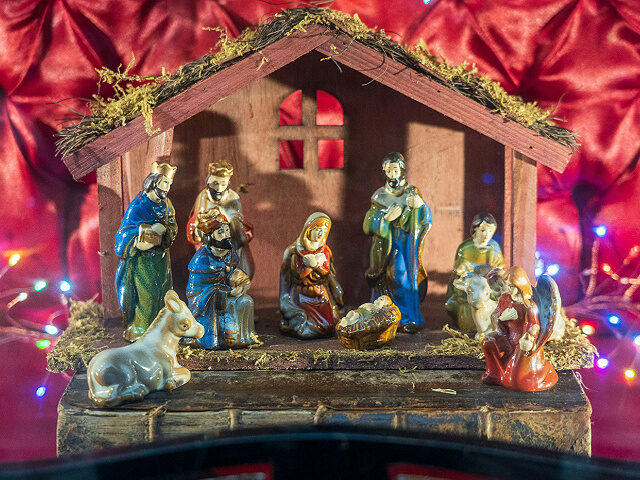
A dispute over a Christmas Nativity display in a small South Carolina town has drawn attention to how local governments handle religious symbols on public property, highlighting questions about authority, community standards, and long-standing legal precedent.

The situation unfolded in Mullins, South Carolina, around Thanksgiving, when the Mullins Beautification Committee began decorating the town’s new marketplace for the Christmas season. According to committee chair Kimberly Byrd, the goal was to create a festive environment that would attract visitors and support local businesses. She said the decorations were intended to make the marketplace feel “like a Hallmark movie” and were paid for entirely by committee members, not by the town. Among the decorations was a Nativity scene placed in a parking lot associated with the market.
Mayor Miko Pickett reportedly asked that the Nativity scene be removed, citing concerns that it could be offensive to residents of other faiths and pointing to constitutional considerations surrounding religious displays on public property. Pickett later addressed the issue in a public Facebook post, writing, “I would like to clarify my reported comment about the nativity scene. I requested that the nativity scene be removed solely from the PUBLIC parking area. The reason for this is the separation of Church and State applies to muncipalities as well, regarding religous symbols on public property and parks [sic].”
In the same post, Pickett emphasized that her position was not intended to single out Christianity or prohibit religious expression elsewhere in town. “We are a community composed of various ethnicities and religious beliefs. Both my family and I are deeply rooted in our own beliefs,” she wrote. “I want to emphasize that I have never stated that nativity scenes should be prohibited in Mullins.”
Byrd declined to remove the display and told Fox News that she intended to keep it in place. She described Mullins as a town where religious institutions are prominent and long established. “Our small town, we have a church on every corner,” Byrd told Fox News. “It’s a faith-based community in the Bible Belt. I’ve been here 53 years of my life and never heard of anything like this happening here.”
Byrd also framed the display as consistent with the meaning of the Christmas holiday itself. “Christ is why we celebrate Christmas,” Byrd added. She said she initially believed the disagreement could be resolved through further discussion with town leadership. “I really thought she would probably change her mind or come back and say, ‘I’m sorry, I made a mistake. Let’s have a meeting about this,’ but nothing.”
According to Byrd, public reaction has largely supported the committee’s decision to keep the Nativity scene. “I never thought I’d have to do anything like this,” she said. “But at the end of the day, we have to stand for what we believe in and what is right.”
The dispute also touches on established legal precedent regarding religious displays on public property. Fox News noted that in the 1984 U.S. Supreme Court case Lynch v. Donnelly, the Court ruled in a 5–4 decision that a Nativity scene displayed by a Rhode Island city did not violate the Establishment Clause when it was part of a broader holiday display that included secular symbols. That ruling has since been referenced in similar cases involving seasonal displays and municipal spaces.
As the situation in Mullins continues, it underscores the ongoing balance local officials face between constitutional guidelines, community traditions, and the use of public property, particularly during widely celebrated holidays that carry both religious and secular significance.



Tell Pickett to Stick it… Merry Christmas ⛄🧑🎄❄️☃️🌲🎄🛷…
So, the city can’t put up with it for a couple of months? We still have no go areas in the country that have been like that for four years or more! First responders can’t get through the barricades and the mayor is whining about Christmas decorations to enhance the town for sightseeing? I thought DEI was over!! 🌲🌲🌲🌲