
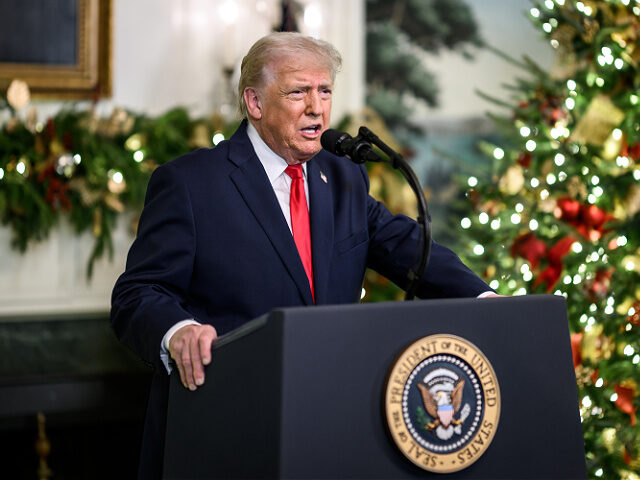
President Donald Trump announced on Christmas night that the United States carried out a military strike in northwest Nigeria targeting ISIS militants, citing reports that the group had been responsible for sustained attacks against Christian communities in the region. The announcement framed the operation as a direct response to escalating violence and as an exercise of presidential authority as Commander in Chief.

“Tonight, at my direction as Commander in Chief, the United States launched a powerful and deadly strike against ISIS Terrorist Scum in Northwest Nigeria, who have been targeting and viciously killing, primarily, innocent Christians, at levels not seen for many years, and even Centuries!” Trump wrote. He added that he had previously warned the group to halt the violence and described the strike as the fulfillment of that warning. “I have previously warned these Terrorists that if they did not stop the slaughtering of Christians, there would be hell to pay, and tonight, there was. The Department of War executed numerous perfect strikes, as only the United States is capable of doing. Under my leadership, our Country will not allow Radical Islamic Terrorism to prosper. May God Bless our Military, and MERRY CHRISTMAS to all, including the dead Terrorists, of which there will be many more if their slaughter of Christians continues.”
The strike follows a period of heightened international attention on Nigeria, where armed Islamist groups have carried out attacks for more than a decade, particularly in the Middle Belt and northern regions. Human rights organizations, religious freedom monitors, and local journalists have documented repeated assaults on villages, churches, and civilians, with Christians frequently identified as the primary victims. These incidents have often coincided with major Christian holidays, including Christmas and Easter, a pattern that has drawn concern from observers monitoring religiously motivated violence.
During a December 16 briefing attended by journalists, Nigerian officials, legal advocates, and religious freedom experts described the situation as a sustained campaign against Christian populations. Steven Kefas, a journalist with the Observatory for Religious Freedom in Africa, highlighted the timing of the attacks, noting their concentration around Christian worship and celebrations. “If this [were] just random criminality, why not attack the Muslims in the Middle Belt on the eve of their celebration, or on Friday?” he asked rhetorically. “You never hear that.”
Nigerian government leaders have publicly disputed characterizations of the violence as religiously driven. President Bola Tinubu has attributed many of the incidents to criminal banditry, land disputes, or climate-related pressures rather than targeted persecution. Tinubu rejected President Trump’s October designation of Nigeria as a Country of Particular Concern for religious freedom, even as international watchdogs continued to report widespread attacks. While Nigeria later declared a state of emergency and replaced its defense minister, reports of ongoing violence and intimidation of victims and journalists have persisted.
According to Open Doors, an organization that tracks persecution of Christians globally, Nigerian Christians experience an average of eight violent attacks per day. The group’s reporting places Nigeria among the countries with the highest number of faith-related killings worldwide. The continued instability has raised broader questions about regional security, the Nigerian government’s capacity to protect civilians, and the role of international partners in responding to non-state militant threats.
The issue has also been referenced by foreign leaders. Israeli Prime Minister Benjamin Netanyahu, in a Christmas Eve message focused on religious freedom, stated that Israel is “the only country in the Middle East where the Christian community is thriving.” He also addressed the situation in Nigeria, saying that “Muslim militant displacement and attacks against Christians in Nigeria — that too must end.” His remarks underscored the growing global attention on the violence and its implications for religious liberty and security beyond Nigeria’s borders.