
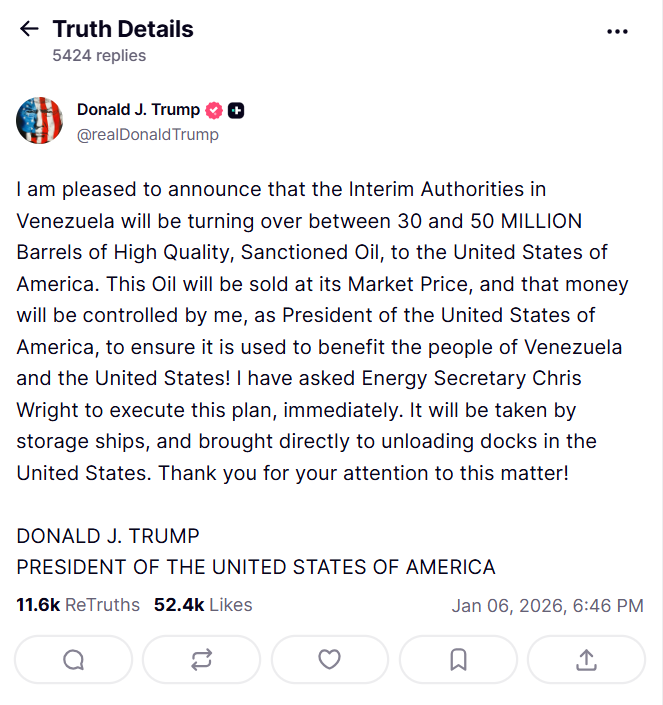
President Donald Trump announced that authorities he described as Venezuela’s “interim authorities” would provide the United States with between 30 million and 50 million barrels of oil that he characterized as sanctioned and high quality. The announcement was made in a post on Truth Social, where Trump outlined how the oil would be handled, sold, and administered, and how proceeds would be directed.

“I am pleased to announce that the Interim Authorities in Venezuela will be turning over between 30 and 50 MILLION Barrels of High Quality, Sanctioned Oil, to the United States of America,” Trump wrote in the post on Truth Social. He added that, “This Oil will be sold at its Market Price, and that money will be controlled by me, as President of the United States of America, to ensure it is used to benefit the people of Venezuela and the United States!” Trump further stated that the oil would be transported by storage ships and delivered directly to U.S. unloading docks.
Trump also said he had directed the Energy Department to carry out the plan without delay. “I have asked Energy Secretary Chris Wright to execute this plan, immediately,” he wrote. “It will be taken by storage ships, and brought directly to unloading docks in the United States.” The statement indicated that the oil transfer and sale would be managed through existing U.S. infrastructure and oversight mechanisms, with proceeds subject to presidential control.
The announcement followed Trump’s statement that U.S. military forces had captured Venezuelan leader Nicolás Maduro and his wife, Cilia Flores. After that development, Trump said the United States would “run everything” related to Venezuela’s oil reserves, signaling a shift in how those resources would be administered. Venezuela has long been subject to U.S. sanctions tied to governance, corruption concerns, and regional stability, and its oil sector has played a central role in both its economy and its international relations.
Reporting cited by Breitbart News noted the scale of Venezuela’s energy resources. According to Nick Gilbertson, “according to the Kobeissi report, Venezuela had, as of Saturday’s oil prices, approximately $17.3 trillion in oil reserves, which exceeds the collective global gross domestic product excluding the United States and China.” That estimate highlights why control, oversight, and disposition of Venezuelan oil have significant economic implications, particularly for global energy markets and for countries involved in sanctions enforcement.
Taken together, Trump’s announcement places Venezuela’s oil reserves within a broader framework of U.S. energy policy, sanctions administration, and executive oversight. The proposed transfer, sale at market prices, and allocation of proceeds raise questions about how sanctioned resources are managed, how revenues are distributed, and how such actions intersect with domestic energy supply, international markets, and ongoing geopolitical developments in the Western Hemisphere.