
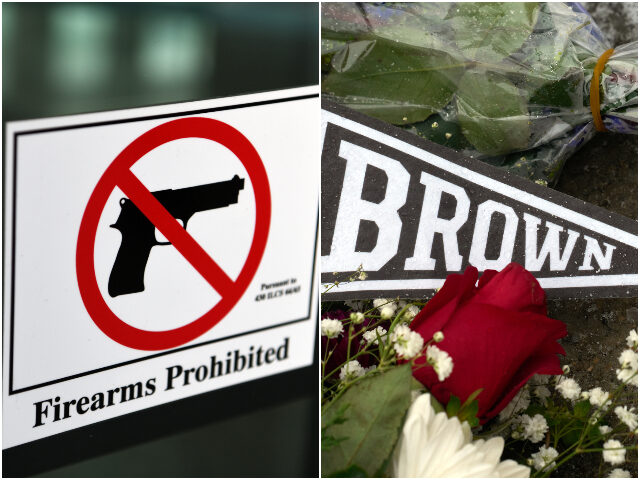
As the search continues for the individual who opened fire at Brown University, attention has focused on the campus’s longstanding restrictions on firearms and how those rules operate during emergencies. Brown University’s most recent Weapons and Firearms Policy went into effect June 27, 2025, and governs all university-owned buildings, grounds, and university-sponsored events. The policy states, “The possession, use, or storage of Weapons or Firearms is strictly prohibited on all University Property and at University-sponsored events, except as authorized under this policy.” The language applies broadly and does not distinguish between students, employees, or visitors, establishing a uniform prohibition across the campus.

Under the policy, licensed concealed carriers are also barred from carrying firearms on campus for personal self-defense. The only exceptions listed are university law enforcement, active and retired members of other law enforcement agencies, and “credentialed armed private dignitary security personnel allowed on campus at the discretion of the Vice President for Public Safety and Emergency Management.” Administration of these exceptions is centralized, placing discretion for armed access in the hands of designated university officials rather than individual license holders.
On Saturday, just after 4:00 p.m., an attacker entered a room in a Brown University engineering building and opened fire. Authorities have confirmed that two people were killed and nine others were wounded in the incident. The attack occurred within campus facilities governed by the university’s weapons policy, and law enforcement has continued to investigate how the suspect obtained and used a firearm during the incident.
The situation has renewed broader discussion around how institutions balance centralized safety policies, emergency response protocols, and individual accountability during violent incidents. Universities across the country commonly adopt similar weapons restrictions as part of their risk-management frameworks, often emphasizing prevention through regulation while relying on law enforcement for armed response. As investigators continue their work, the Brown University shooting adds to the ongoing national record of incidents that occur in regulated environments, raising questions about how such policies function in real-world emergencies and how public safety responsibilities are allocated during rapidly unfolding threats.