

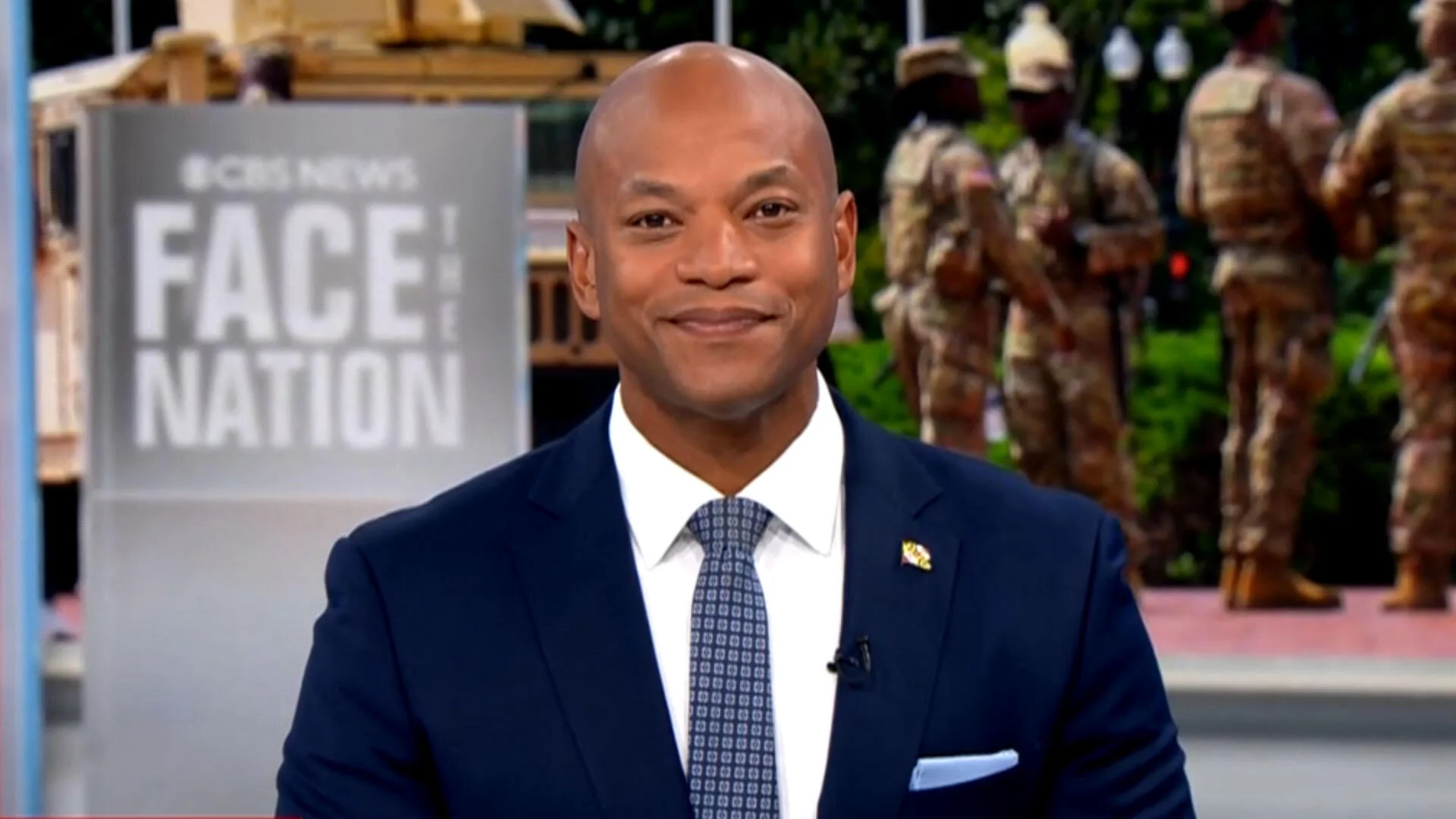
Governor Wes Moore (D-MD) went on CBS’s Face the Nation Sunday to criticize President Donald Trump’s decision to deploy National Guard units in Washington, D.C. as part of a federal crime crackdown. Moore didn’t mince words, calling the operation “not sustainable” because of its cost, scope, and what he described as constitutional concerns.

The interview shed light on a growing debate: whether the federal government should step in aggressively to restore order in America’s capital city, or whether that responsibility should remain in local hands—even when local leadership has struggled for years to control rising crime.
Host Margaret Brennan pressed Moore on his opposition to the deployment. “So they’re here in DC- there are guardsmen from six different states on the street. The mission is, quote, ‘beautification, duty and support.’ The defense secretary has authorized them to carry M4 and M17 rifles, but to date, we have not been able to locate anyone armed within the National Guard on the streets of DC. Why, though, are you so opposed to this deployment?”
Moore responded with a list of objections. “Well, there’s- there’s plenty of reasons. You know one, it is not sustainable. You cannot continue this type of pace of operations, particularly when you’re when it’s costing over a million dollars a day in order to do this. The second, it’s not scalable. You’re not going to be able to do this in every single major American city, particularly when many of the cities that have the highest crime rates are the places that have actually deployed their national guards to Washington, DC. So who’s going to- who’s going to go do the work in their cities? The third, it’s unconstitutional. It’s a direct violation of the 10th Amendment, and for a party that talks about state rights, it’s amazing how they’re having such a big government approach in the way they’re conducting public safety. The fourth reason is because it’s deeply disrespectful to the members of the National Guard. As someone who actually deployed overseas and served my country in combat, to ask these men and women to do a job that they’re not trained for is just deeply disrespectful. And so when we’re thinking about all of these lasting factors, when we’re thinking about the fact that it serves as a distraction from the fact that the President’s disastrous economic policies are making everything more expensive for everyday Americans- is making life harder for everyday Americans, there is a multitude of reasons that I am against this, and I will not authorize the Maryland National Guard to be utilized for this.”
At the center of Moore’s critique was cost—“over a million dollars a day” for operations he deemed unsustainable. That figure might alarm taxpayers, but many would argue the far higher cost is what citizens pay when violent crime is allowed to spiral unchecked. Businesses close, families flee, and cities suffer long-term economic decline. Washington, D.C. has seen persistent crime issues for decades, and while local leaders often talk about reform, the results have been limited at best.
Moore also framed the move as unconstitutional and “a direct violation of the 10th Amendment.” Yet many conservatives would see the situation differently: when local governance fails to provide basic security, the federal government has a duty to step in—especially in the nation’s capital, where public safety has direct implications for national security. Protecting the streets of D.C. is not just about crime statistics; it’s about ensuring the seat of government itself remains safe, functional, and respected.
His comments on scalability echoed another long-running debate. Moore asked whether this approach could be replicated in “every single major American city.” Of course, the reality is that the Guard is not being deployed nationwide—it is being used as a temporary, targeted response in a city where violent crime has become a symbol of broader urban decline. Suggesting it must be scaled everywhere is a political framing, not a practical reality.
Perhaps most telling was Moore’s charge that the deployment was a “distraction from the fact that the President’s disastrous economic policies are making everything more expensive for everyday Americans.” That critique attempts to link crime policy to economics, but it overlooks a critical truth: public safety is foundational to prosperity. Without safe streets, no economic policy—good or bad—can deliver meaningful relief. Investors won’t build, families won’t settle, and opportunity dries up when fear rules neighborhoods.
Moore’s military service gives weight to his concerns about Guard members being tasked with roles outside their training. But many conservatives would note that Guard units have often been called upon in domestic crises—from natural disasters to riots—precisely because they represent disciplined, organized manpower capable of restoring order when chaos overwhelms local capacity. To suggest that their presence in D.C. is “disrespectful” risks dismissing the sacrifices these men and women willingly make to keep Americans safe, both abroad and at home.
In the end, Moore’s rejection of the Maryland Guard’s participation underscores a deeper philosophical divide. On one side is the argument for local autonomy and restraint in federal power. On the other is the recognition that unchecked crime in the nation’s capital undermines faith in government, erodes the rule of law, and sends a dangerous message to both citizens and adversaries abroad.
For many Americans watching the violence play out on city streets, the real question isn’t whether the Guard’s presence is “sustainable.” It’s whether the cost of inaction is one the country can continue to afford.








You claim the protection of people in Washington DC are costing $1 million a day that’s wrong. These National Guard guys get paid whether they’re in DC or sitting around the fort smoking cigarettes thinking of women what’s the cost of somebody’s life from murder in Washington DC or the death by fentanyl in Washington DC You’ve got your priorities mixed up in the story.